
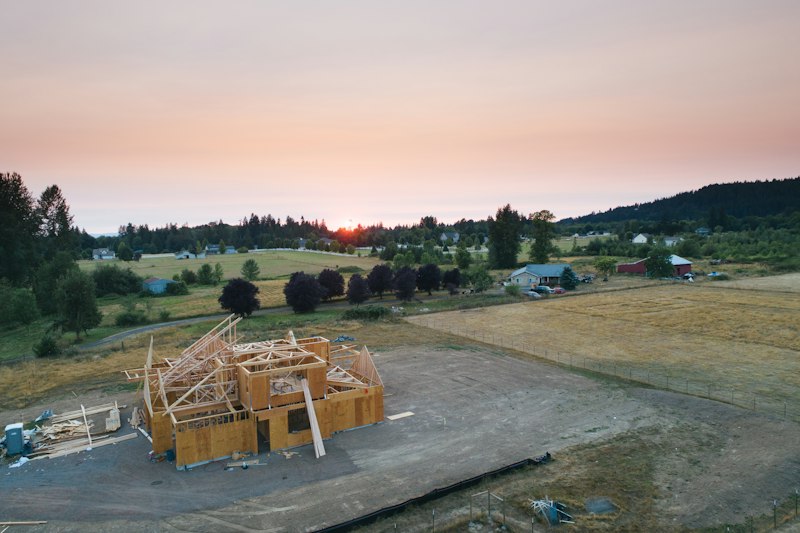
This brand-new single-family home in Edmonds, north of Seattle, achieves both exceptional cash flow and strong appreciation potential in a livable, value-retaining seaside community — a rare combination. Listed at approximately $1.15M–$1.17M, it commands long-term rent of $4,300–$4,500/month and projected Airbnb income of approximately $100K annually. The key was purchasing a scarce new home with rental and appreciation potential at a reasonable price.
Project Overview
This development is located in the Esperance neighborhood of Edmonds, adjacent to the beloved local Esperance Park. The community consists of only 5 single-family new homes on a quiet cul-de-sac with a 25 mph speed limit — well-suited for families with children.
The floor plan is 4 bedrooms / 2.5 baths with approximately 2,200–2,400 sq ft of interior space and approximately 3,500–3,600 sq ft of yard. Priced at approximately $1.15M–$1.17M with HOA of only $39/month. From this community, normal commute time to Amazon's South Lake Union headquarters is approximately 25 minutes, or 40–45 minutes at peak — competitive with the Eastside. For tech families working on the west side of the city, this commute range paired with new-home quality is a genuinely rare combination.
Why Edmonds Is a Scarce Market
Edmonds is the only city in the entire Seattle area where the main street leads directly to a bay waterfront — locals call it 'little Kamakura.' It combines coastal views, mature amenities, and an arts atmosphere, and is Washington State's first Creative Arts District city. It is a textbook closed market with a level of land scarcity that is difficult to overstate.
Over the past 20 years, the total number of new single-family homes built in all of Edmonds has not exceeded 800 — an average of approximately 40 per year — in a city of approximately 42,000 residents, ranked 30th among Washington's 281 cities. In other words, annual new single-family supply equals approximately 0.1% of the population. Any new home here is inherently scarce. This rigidity of supply is the underlying reason Edmonds property holds value over the long term — no matter how markets fluctuate, new supply cannot quickly increase.
| Metric | Data | Notes |
|---|---|---|
| 20-year new single-family total | Under 800 units | ~40/year average |
| City population | ~42,000 | Ranked 30th of 281 WA cities |
| Annual new single-family as % of population | ~0.1% | Extremely rigid supply |
| HOA monthly fee | $39 | Low holding cost |
Why Cash Flow Is High
High cash flow starts with buying at a reasonable price. In a livable, value-retaining seaside community, purchasing a new home with a yard for approximately $1.15M is already a value opportunity — in the same neighborhood, a lot expanded to approximately 7,200 sq ft would immediately push the price above $2M.
On the rental side, long-term rent reaches $4,300–$4,500/month, and projected Airbnb short-term income is approximately $100K annually. Even at a market investment mortgage rate of approximately 7% with a 25% down payment doing Airbnb, the property can generate $1,000+/month in positive cash flow; if choosing long-term rent with 20% down plus the builder's special incentive, cash flow can reach breakeven. By comparison, Seattle market properties typically require approximately 40% down to achieve cash-flow breakeven — this home's capital efficiency is significantly superior.
| Operating Method | Revenue | Down Payment / Cash Flow |
|---|---|---|
| Long-term rent | $4,300–$4,500/month | 20% down + incentive → breakeven |
| Airbnb short-term | ~$100K/year | 25% down → $1,000+/month positive CF |
| Seattle market baseline | — | Typically needs ~40% down to break even |
Why There Is Appreciation Potential
Edmonds offers scarce coastal resources, high livability, strong long-term value retention, and an improving demographic profile. The 65+ population represents 22.5% of residents — meaningfully above the national average of 16.8% — with high-net-worth retirees and young tech professionals co-existing in a healthy, stable community.
As Amazon, Apple, Meta, and Google progressively implement return-to-office policies, many engineers are relocating from the Eastside to the west side of the metro area. Edmonds and neighboring Shoreline have become popular destinations for tech workers, driving rapid school quality improvement — one local high school's rating jumped from 2 to 5 within a single year. Holding this new home provides both current cash flow and participation in the community's long-term appreciation — a 'cash flow + appreciation' dual-engine asset that is genuinely uncommon.
How the Builder Incentives Lower the Entry Threshold
The reason this property's cash flow logic works is also due to two non-public builder incentives. First: choosing the builder's designated lender qualifies for a special 7-year ARM rate, starting as low as 2.75% in year one, 3.75% in year two, 4.75% in year three, then floating with the market thereafter. Second: an additional $25,000 purchase discount.
Combined, these significantly reduce the entry threshold and early monthly payment pressure. In the Seattle market, achieving cash-flow breakeven typically requires approximately 40% down. With this home's incentive structure, buyers only need 20–25% down to approach or achieve breakeven — materially reducing capital required. Buyers should note the risk of the ARM rate floating after year 8 and plan a refinancing or sale exit strategy in advance.
Risk Disclosure and Exit Strategy
| Risk Factor | Specifics | Mitigation |
|---|---|---|
| ARM rate float | Market-rate after year 8 | Plan refinancing or sale in advance |
| Short-term rental policy | Edmonds short-term rental regulation | Verify local STR permit requirements |
| Rate environment | Investment mortgage ~7% | Model long-term rent as floor |
| Liquidity | High-price properties have narrower buyer pool | Lean on scarce location for resale |
The prudent approach is to run both best-case and worst-case scenarios: best case is full Airbnb occupancy at $100K/year; worst case is STR restriction forcing long-term rent only, which still should not create large negative monthly cash flow. As long as the long-term rent scenario produces cash flow near breakeven, combined with Edmonds' scarce location and appreciation potential, the downside risk of this investment is relatively manageable.
Property Selection Logic: Location, Cash Flow, Potential
| Dimension | This Property's Performance | General Evaluation Standard |
|---|---|---|
| Location | Scarce coastal community, closed market | Supply cannot quickly be replicated |
| Cash flow | Long-term rent can break even, short-term rent positive | Rent coverage ratio relative to payment |
| Potential | Tech population inflow, school quality rising | Whether fundamentals are continuously improving |
All three are necessary: location without cash flow is a liability; cash flow without potential limits appreciation; potential without a reasonable price carries too much risk. This Edmonds new home is rare in simultaneously achieving all three at a reasonable price point — which is why it is worth sharing.
Summary
Good deals are not found by luck but by clear criteria and patient selection. This Edmonds new home validates a complete property selection framework: location (livable, value-retaining scarce coastal community), cash flow (reasonable price plus rental potential), and potential (tech population inflow and school quality improvement) — all three achieved together.
For Seattle owner-occupant/investor buyers, rather than chasing premium prices in overly homogeneous hot markets, consider directing attention toward closed markets like Edmonds where supply is constrained and fundamentals are continuously improving. When evaluating specific properties, model cash flow under both long-term and short-term rental scenarios, and incorporate down payment percentage, mortgage rate, and builder incentives into the calculation to ensure the cash flow logic genuinely holds.