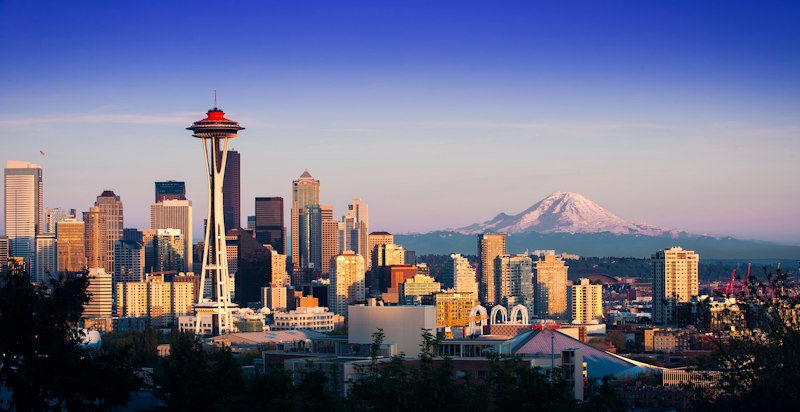
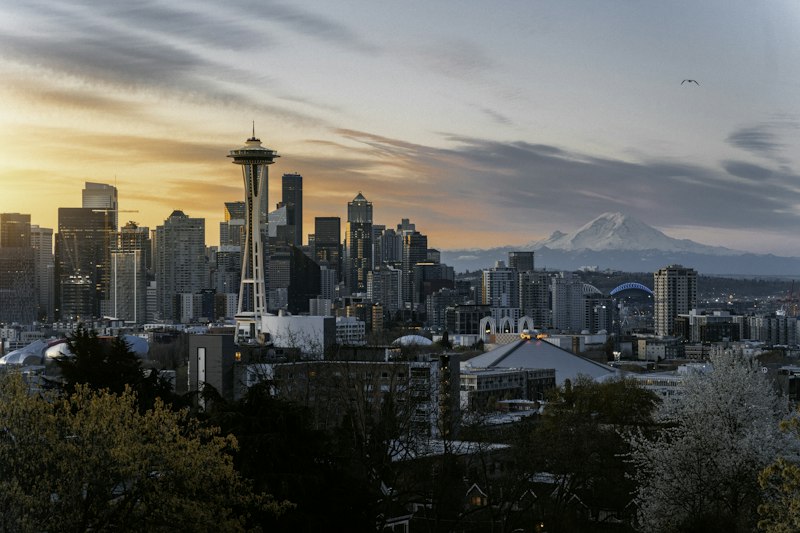
If you hate rain, you should actually consider moving to Seattle. Climate data shows Seattle's urban core has annual rainfall of only ~37 inches — lower than Miami, Houston, and Atlanta — with almost no hurricanes, tornadoes, or extreme heat. Combined with rain-shadow communities along Puget Sound, its livability far exceeds the 'rain city' stereotype.
Seattle's Actual Rainfall Is Wildly Overstated
The real rainfall data and public perception diverge significantly. Seattle City itself gets ~37 inches annually — the lowest in the entire metro area. By comparison, the Eastside's major cities consistently run 14–24% wetter. What makes people think Seattle 'always rains' isn't total rainfall but cloud cover days. In fall, winter, and early spring, Seattle's skies are often overcast. Higher latitude means shorter winter daylight hours and early sunsets, reinforcing the dreary feeling.
Rain Shadows: Same Metro, Vastly Different Experiences
Seattle sits on the eastern shore of Puget Sound, with the Olympic Mountains along the Pacific coast to the west. Pacific warm, moist air moving east lifts over the mountains and dumps heavy precipitation on the western (windward) slopes; as air descends the eastern (leeward) side, most moisture is spent — rainfall drops sharply. This is the rain shadow effect.
Seattle's core falls within the rain shadow, while Bellevue, Redmond, and Kirkland lie outside it and receive more rain. Sammamish, close to the Cascade Range on the east side, sits under another uplift zone for Pacific moisture — 24% more rainfall than Seattle. The Puget Sound Convergence Zone causes north and south air currents to merge near Everett, giving North Everett above-average rainfall and occasional localized heavy downpours.
Key Data
| Location | Annual Rainfall | Notes |
|---|---|---|
| Seattle City | ~37 in | Lowest in the metro |
| Bellevue | 42 in | 14% more than Seattle |
| Kirkland | 43 in | 16% more |
| Redmond | 44 in | 19% more |
| Sammamish | 46 in | 24% more — Cascade-foothills uplift |
| Everett | 45 in | 22% more — Convergence Zone |
| Miami | 61 in | 33% more than Sammamish |
| New Orleans | 64 in | Far more than Seattle |
| Seattle winter sunny days | From ~2% in 2010 to now >25% | ~1,250% growth in 14 years |
Few Extreme Weather Events — An Overlooked Advantage
More important than total rainfall: Seattle is almost entirely spared from extreme weather. While the Eastern and Southern U.S. cycles through heat waves, storms, and flooding, Seattle's climate is almost luxuriously mild — no hurricanes, no tornadoes, rarely extreme heat or cold. For people who truly dread 'being beaten by weather,' this is a massive advantage.
Even the rainiest area, Sammamish at 46 inches, is still below-average nationally. Miami (61 in), Houston (54 in), Atlanta (50 in), New Orleans (64 in) — all those 'sunshine state' cities — get far more rain than the Seattle metro.
Climate Is Continuously Improving
Due to global warming, Seattle's share of winter sunny days has risen from ~2% in 2010 to now more than 25% — ~1,250% growth in 14 years, and still accelerating. At this pace, Seattle's future sunshine hours may approach or even surpass California's Bay Area, reinforcing its West Coast livable-city status.
Why the Stereotype Diverges From Data
Seattle's 'perpetually rainy' label comes more from rain frequency and the appearance of the sky than actual precipitation volume. The typical Seattle weather is drizzle and clouds, not downpours; hours of light mist leave a deeper psychological impression than a brief thunderstorm while contributing little to annual statistics. High-latitude winter short daylight hours amplify the subjective 'gloom' — but this perception is easing year by year as sunny days increase.
Summary
For Seattle Chinese-American buyers who care about weather, prioritize rain-shadow communities when choosing location. The urban core and nearby leeward areas receive notably less rain than Eastside Sammamish, Everett, or mountain-foothills cities. If commuting allows, Puget Sound's eastern-shore areas away from the Cascade foothills maximize sunny days.
Don't let the 'rain city' label drive your homebuying decisions. Combining total rainfall, extreme weather risk, and continuously improving sunshine hours, Seattle is an underrated competitor among livable U.S. cities — worth a fresh look from families who fear extreme weather.