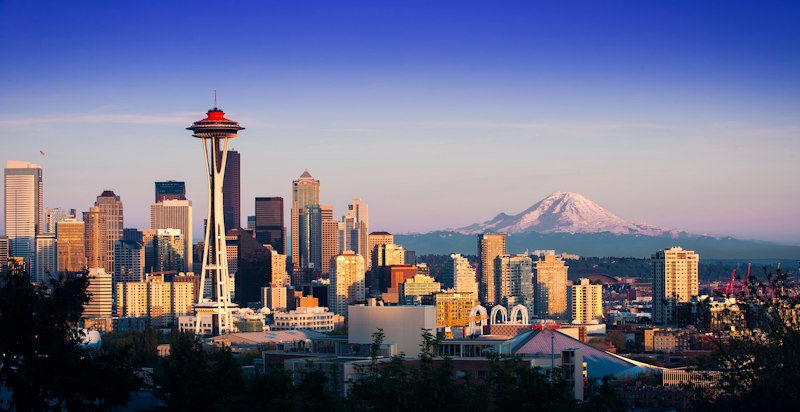

Seattle is re-emerging as the top homebuying destination for both American buyers and Chinese immigrant families. After the pandemic-era population outflow and remote-work surge, recovering tech employment, return-to-office mandates, the no-state-income-tax advantage, and relatively affordable prices are collectively pulling homebuying demand back to the city's core employment zones — giving Seattle's housing demand a more solid floor than at the peak of remote work.
Tech Employment Recovery and Return-to-Office
Tech company hiring is recovering, and major employers like Microsoft and Amazon have broadly implemented return-to-office requirements, drawing large numbers of employees back to housing near core employment zones. Amazon requires 5 days per week in-office; Microsoft, Meta, and Google generally require 3–5 days. The commute demand that was eroded during the remote-work era is returning.
This directly boosts housing demand in Seattle's core and on the Eastside (Bellevue, Redmond, Kirkland). The return-to-office trend's essence is making 'living near work' a necessity again, providing a solid demand base for prices in core employment zones.
Tax and Affordability Advantage
Washington State charges no personal state income tax — a long-standing structural advantage. Compared to California, Greater Seattle's home prices are still relatively affordable overall — the same budget often buys more space and better school district access. For high-earning tech families who prioritize tax efficiency and after-tax income, this is a real draw.
The Stability of Major Corporate Anchors
Seattle is home to Microsoft, Amazon, Boeing, Starbucks, Costco, Nordstrom, Alaska Airlines, Expedia, T-Mobile, and other Fortune 500 headquarters. In an era where AI is becoming a productivity force, large companies with capital and technology moats are more resilient to risk. Their headquarters clustering effect keeps Seattle's employment opportunities and income levels resilient through economic cycles — providing long-term housing demand support.
Population and Community
Greater Seattle's Asian population share is approximately 17.1% — higher than California's 15.5%. Bellevue's Asian share rose from approximately 27% in 2010 to approximately 41% in 2020, reflecting a predominantly first-generation immigrant population. The community networks, Chinese supermarkets, Chinese schools, and professional services formed by this immigrant concentration further strengthen the city's appeal to subsequent arrivals.
For families planning to settle long-term, whether a city has mostly newer or longer-established immigrants often determines how easy integration feels and how well lifestyle fits. Seattle's predominantly first-generation immigrant community structure is especially welcoming for Chinese families arriving later.
Climate: The Reality Behind the Stereotype
Seattle's rain-and-gloom stereotype doesn't hold up to data. Seattle's annual rainfall is approximately 37 inches — lower than New York's 49 inches, Vancouver's 44 inches, and Shanghai and Hangzhou's approximately 45 inches. Annual sunny days total approximately 152 — only 8 fewer than Hangzhou and 13 fewer than Shanghai.
Thanks to the Pacific warm current, Seattle winters are mild (typically 40–50°F); summers consistently around 77°F with long daylight hours, often called America's best summer. Within an hour's drive you have mountains, glaciers, forests, lakes, and bays — exceptionally rich outdoor resources.
Summary
More and more people are putting Seattle at the top of their homebuying list — not by accident, but as the result of employment, taxes, prices, climate, and livability working together. Tech employment recovery and return-to-office trends pull demand back to core zones; no state income tax and relatively affordable prices provide structural appeal; livability and a mature Chinese community support long-term settlement decisions.
For Chinese families planning to buy in Seattle, prioritize the Eastside's core employment corridor and quality school districts — these areas have the most solid demand floors and strongest downside protection. Take advantage of Washington State's no-income-tax benefit to optimize long-term after-tax returns. In an environment of high rates and episodic employment volatility, Seattle's continued population and employment recovery provides medium- to long-term price support — rational buyers need not miss the positioning window due to short-term market noise.