
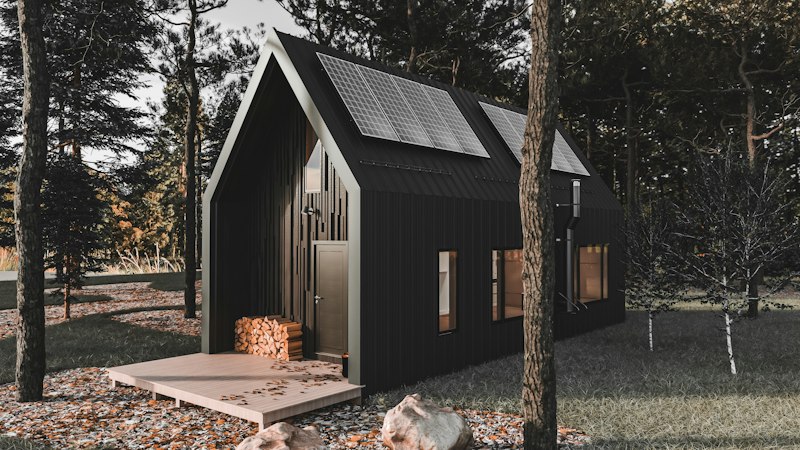
Many people have been asking my opinion on Musk's $50K prefab cabin. Here's my direct answer: it's a total scam.
First: that company is called Boxabl and has absolutely nothing to do with Musk. Musk himself has repeatedly tried to distance himself from it, but waves of social media content keep using him as a clickbait hook.
Second: the so-called $50K cabin, once you add foundation, utilities, and transport, typically costs $200K+ to actually move in. The $50K number exists purely to generate attention.
Third and most damning: Boxabl has 200,000 orders backlogged with only 300 actually delivered. 200,000 versus 300 — that's a textbook Ponzi structure: using future orders to prop up today's story.
But today we're not just talking about Boxabl. We're talking about the real, deeply misunderstood problem behind it — why US modular construction can't scale. And why the law the Senate passed 89-10 on March 12, 2026 will fundamentally change this sector.
Chapter 1: Why Is Modular Stuck at 5%? A Financial Problem, Not a Market Problem
In 2024, only 8.8% of US new apartments used modular construction. Sweden: 84% of single-family homes contain prefab components. America: 5%. Why such a gap?
Most media says 'Americans are conservative' or 'building codes are too fragmented.' Both wrong. The real answer: loan disbursement timing.
Traditional construction loans disburse by on-site progress — foundation complete, bank releases payment; framing complete, another payment. This was designed for manual on-site construction.
Modular is the opposite. Factory production requires a large upfront payment on day one — locking in production lines, purchasing materials, paying workers — before a single brick is laid on-site. Banks say: I can't verify progress, I won't lend. Factory says: you won't lend, I won't start production.
A dead-end that paralyzed this industry for nearly 20 years.
The cost of this dead-end: my Burlington 120-unit apartment project — traditional construction would take 2 years; modular delivered the main structure in 4 months. Traditional: $300/sq ft; modular: $150/sq ft. That math (6x faster capital turnover, 50% cost savings) translates to annual project returns going from 10% to 100%+ with the same land and building. That's not optimization — it's a different league entirely.
Yet almost no developers do this because every project requires manually negotiating a custom financing structure with banks, investors, and factories from scratch. In the US, doing modular means you're not building housing — you're building financial infrastructure. Each project is handcrafted, impossible to replicate at scale.
Chapter 2: The ROAD Act — Federal Government Directly Breaks the Dead-End
On March 12, 2026, the Senate voted 89-10 to pass the 21st Century ROAD to Housing Act. The House is processing it now; the administration has made clear it will sign.
Two key provisions: Section 301 gives modular construction federal-level identity certification — national unified standards replace the chaotic state-by-state patchwork. Section 302 brings FHA directly into the process, mandating it remove lending obstacles and revise its draw schedule to support factory-stage disbursements.
These two provisions together mean the custom financial infrastructure that developers like me spent years manually building becomes an industry-wide standard channel. New players don't need to negotiate from zero. Industry coordination costs drop structurally.
Are ADUs a catalyst for modular? Unfortunately, no. ADU scale is too small; factory production lines won't run a dedicated line for one or a few ADUs — the economics don't work. What makes modular economically viable is 100+ unit apartment projects. That's exactly what Sec. 302 addresses — not backyard cottages.
Chapter 3: How Do Investors Participate?
Two paths:
Path 1 — Private equity investment in modular development projects: The ROAD Act will significantly lower lending difficulty. My projects in Washington State currently deliver 100-200% project-level profit margins — this sounds improbable, but it reflects three unique windows: first-mover advantage (very few players, I've spent 3 years building out product performance, site coordination, and factory relationships, including strategic partnerships with America's two largest modular factories); exclusive lending access (currently the only developer in Washington State with large-scale modular development financing — this scarcity lasts roughly 2-3 more years before ROAD Act implementation normalizes it); and leverage structure (I use $3-5M startup capital to personally guarantee $10M+ in development loans — investors enter on the equity side while I absorb all the downside risk).
Path 2 — Land owners with development-ready parcels: if you own land near transportation corridors with upzoning potential and sufficient area for 100-200 unit projects, your asset is being repriced right now.
Three things to track: (1) When the House passes the ROAD Act — if signed before end of 2026, modular financing transforms starting 2027; (2) Washington State multi-unit permit data over the next 12 months — modular-led projects recover first; (3) FHA's specific modular implementation rules — the bill is the framework, the rules are the actual tools.
Boxabl's story is noise. The ROAD Act is the signal. Don't stare at the noise.